Wednesday, April 20, 2016

Valve lash adjustment, a diesel engine tune up

We have a big honking Detroit Diesel Series 60 engine in our motorhome, 858 cu. in., 515 HP, with 1650 ft/lbs of torque.  It is pretty bullet proof other than keeping the oil and filters changed, and changing the fuel filters regularly to keep it drinking nice clean fuel. But like any engine it requires a tune up of sorts, the manufacturer says to have the valve lash checked at 60,000 miles initially.  We contacted the dealer at 60,000 miles and were told to wait awhile, get it to at least 80,000-90,000 miles and call back, so when we reached that mileage he said he'd still wait a little longer.  In his experience he had never had one that needed any adjustment at that low a mileage and I would be wasting my money, and it's not cheap to do.  So when we reached 109,000 miles and told him we were planning on a circumference of the US with another 8-10,000 miles this year, he said it's time.

Now what is valve lash?  Remember there is no ignition on a diesel engine, and it runs on high compression, the valves, intake and exhaust open and close by the turning of the camshaft.  The lobe of the cam pushes up on the rocker arm that pushes down on the valve tappet causing the valve to open.  The lash is the carefully measured space between the rocker arm and the valve tappet.  Too little space and the valve will not completely close and too much causes noise and excess load on the valves and valve train components.  It causes the valve to slam open and close instead of riding the cam lobe smoothly.  You can read more about it here if you'd like.


So we set up our appointment with the caveat that the total cost of the job would be determined by how tough it was to access the engine and work on it, a lot more challenging in a motorhome than a truck!  And most of the service places really don't like working on coaches:)  We were quoted between $550- $900 for the job.  We were confident ours would be quite accessible as our manufacturer did a relatively good job of providing real access to the the engine.  


We arrived at the Detroit Diesel service center Sunday afternoon and backed up to our assigned bay door.

Camp Detroit Diesel!
We actually lucked out in that the service manager, Steve, happened to be there when we pulled in, so he confirmed the bay and the job, so we were ready for them at 7:30am in the morning.  Jan and I removed all our stuff from our rear closet, that's where the access is, and we pulled off the access panels and overall made sure we provided as much room  as possible.

Right at 7:30, we met our tech, Steve also, and he remarked that it looked like it would be easier than he anticipated, good news.  

All ready for Steve
He jumped right in and got the valve cover off, he had to remove the air cleaner first to provide room to the engine from the outside as well.
The valve cover

Valve cover popped off

The top of the valves and the two Jake brakes
Now the next question is what is a Jake Brake?  On a diesel engine you don't have any restriction on the air coming into the engine as you do on a gas engine.  On a gas engine you stop the air flow into the engine when you come off the gas providing compression braking. On a diesel the same amount of air enters the engine whether the throttle is open or closed, you just add fuel with the throttle.  With a Jake brake or compression release brake, a device holds open the exhaust valves to release compression from getting to the crankshaft.  This happens when you have the switch in the on position and come completely off the gas pedal, it provides a lot of slowing power.  Anyway the assemblies you see on top of the valves are the Jake brakes and they have to come off to get to the valves.
One of the Jake brakes lying on the floor

Now you can see the rocker arms in the middle and the top of the valves
along the right side.  The camshaft runs along the left side.
So once Steve got to this point he was then able to turn the engine manually and adjust the lash for each valve in sequence, then after the valves were all adjusted he reinstalled the Jake Brakes and then adjusted each one of them.  Finally he buttoned the whole thing up after ensuring each bolt was torqued to the proper value.
Steve has reattached one Jake Brake so far and is
torquing the bolts
After reinstalling the air cleaner and making sure everything was done, we fired it up, ran it at high idle for a bit, making sure there were no leaks.  All done!!  And the verdict, because of our good access and Jan and I making sure everything was completely out of the way, the final bill was $538!  Awesome.  So now that we are all "tuned up", we should get another couple miles per gallon, HA, wishful thinking, but maybe a 1/2 mpg:)  They said we should be good for another 100-150,000 miles.

Saturday, April 16, 2016

Quiet time in Cedar Key

We came up to Cedar Key for a few days, and were planning to meet our good friends, John and Diane, from Atlanta, but they had a personal loss in their family and could not come.  Our prayers are with them.  We booked this time a year ago when we came here for the first time, and although the weather hasn't been cooperating completely, we have been having a good, but quiet time.  We are staying at the Low Key Hideaway, a small spot with only 3 RV sites, right on the water.
Our view right from our site
  
We've gone on a few hikes, saw a baby eagle in a tree scoping things out.
Time for lunch?
The hikes are pretty short here, but the cloudy weather has made it very pleasant for walking.  We went into the Lower Suwannee National Wildlife Refuge, a few miles away right along the Suwannee River.
A net set out for mullet, we believe

A baby alligator, momma just left!

There were at least 5 of them

A huge spider that was trying to get me!

And these little crabs were all over the paths,
thousands of them!
Right next to us is a clam farm, Southern Cross Sea Farm, and we noticed that they were giving a free tour on Friday, intrigued we stopped by.  It was fascinating learning how they farm clams, right from breeding them, starting them in a hatchery, then nursing them to a big enough size that they can be set out on the gulf floor to grow larger, then finally hauled in and sized and put in their final bags for 12-18 months until they are harvested for selling.  The process takes about 2 years, and this sea farm yields around 120 million clams a year!  There is a lot of work involved.  We learned that the nutrient rich waters of the gulf here around Cedar Key is the reason they are here.  We found out clams are voracious eaters, feeding 24/7 constantly, so it is absolutely necessary to get them in the gulf water as soon as possible, there would be no way they could grow enough algae to feed them.  They are raised in bags to enable the farmers to harvest them and also protect them from predators.  

There is a gestation time of 24 hours, and then they are fully developed clams, and we were able to see them in the microscope, yeah they are that small.  They can swim at this point in their life and they are raised in the nursery until they are about 4mm, when they are put in the gulf.  They put 15,000 of them in each bag for another 3 months until they grow to about the size of a dime, then they are transferred into a grow out bag at 1200 per bag until harvest.  When they get an order, they go find the approximate size they need, there are several different sizes, harvest them, clean them, and sort them out as to number and size.

The owner starting the tour

Where it begins with the "Mom and Dad" clams
They are tricked into breeding by fluctuating the temperature
as nature would do in the spring and the fall

The special algae they grow to feed the babies while they are in the nursery

There are thousands of tiny clams in each bucket here in the nursery
They are about the size of grains of rice

As they grow they are set in the containers, one of which
he is pulling out of the dock

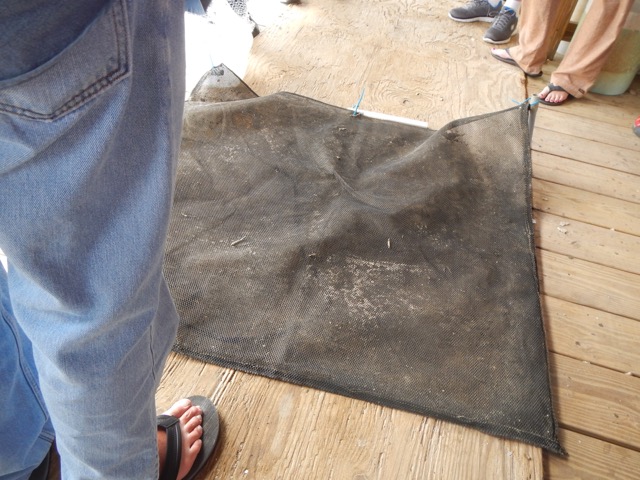
These are the bags that they go in to be placed out in the gulf

The sorting machine

Each bag color is a different size

Clams moving down the sorting machine 

Clams packed, sized, and bagged, ready for shipment
It was a great take and we learned a lot, this farm also started farming oysters about 3 years ago, and Jan and I were able to eat a dozen delicious raw ones at a local restaurant!

So a few very good lunches were had by us, before we get ready to move into service mode as we make our way over to Detroit Diesel to have some maintenance done on the engine, not bad after 109,000 miles, then back to Creative Coach for some body work, paint, new 3M film on the front end, and, of course, fixing our wayward awning.  I'll catch you up on that saga later.